As long as there are Destructive Karmas, the soul is caged in a body and will have to experience pain and suffering in many different forms. (Jainism: Concept of Karma)

I can no longer fight it. Bedridden for several days, I find that my brain has developed grudges against any food I smelled or tasted in the last week. Food I loved now triggers an immediate gag reflex. Even oatmeal, a trusted breakfast ally, has been added to the blacklist hanging in the appetite department. The most common response I hear, especially from Westerners: “Welcome to India.”
Those hours where misery overrides sleep, I’m left contemplating the nature of existence (not for any noble reason—I simply want to find an escape hatch into a better dimension). In Buddhist analysis, when seeking the object that defines you, one discovers a never-ending series of subdivisions—arms, fingers, nails, eyes, nerves, cells, bacteria, molecules. So what—and where—exactly are you? Who is the one suffering at this moment? Am I really me, or just a tightly united nation of cells operating under a common genetic constitution? Perhaps the turning point, 750 million years earlier, went something like this:
We the cells of Otavia antiqua, in order to form a more perfect organism, establish Justice, insure domestic Tranquility, provide for the common defence, promote the general Welfare, and secure the Blessings of Liberty to ourselves and our Posterity…
One evening after dinner, when my body’s immune cells received the hormonal news flash that giardia[1] arrived, they zipped over to the intestinal frontline to “kill us some trophozoites.” Despite the advanced consciousness we’ve gained over thousands of evolutionary cycles, individual cell warfare remains quite primitive.
Perhaps some kind of negotiation would be more civilized. Imagine sitting at a hole-in-the-wall restaurant (perhaps close to where you’re living in Northern India because you thought it would be a convenient place to get a meal and boy were you wrong), raising a spoon to your mouth, and a tiny chorus sings out “Hello! We’re giardia. Give us a petri dish filled with bile salts or we’re going to colonize your intestines.” I’d settle for paying monthly fees to the amoeba mafia if it meant staying healthy, but these guys don’t operate that way. In fact, there are “several ways in which the parasite evades the defences,” such as “by altering the proteins on its surface, which confounds the ability of the infected animal’s immune system to detect and combat the parasite.”[2] Scientifically speaking, they’re underhanded jerks. Which is why there is no alternative but to get angry and kill them all.
Microscopic invaders can take down anyone—even a heavyweight champion has no defense against these invisible opponents. Twisting up further into my tangled sheets, I realize what we need in this situation are some laser-wielding nanodoctors zapping trophozoites lodged in the gastrointestinal tract, just like in one of those first-person shooter video games. If that game doesn’t exist already, someone should make it… a project to consider if and when I recover.

Many animals, including humans, are believed to have evolved from communities of individual flagellated eukaryotes. From that perspective, giardiasis is somewhat ironic—despite our common heritage, today we find ourselves engaged in turf warfare over the nutritious resources near the stomach lining.


For many parasitic organisms, the ability to bind tightly to host tissue is necessary for pathogenicity and survival. (PMCID: PMC1459675)
…they colonize the small intestine by attaching to the intestinal mucosa using the ventral sucking disks (Giardiasis)
Giardia is in most of the world’s rivers and streams. Hikers and travelers in the developing world are at the highest risk for ingesting the cysts, which break open in the presence of stomach acids, releasing rapidly multiplying trophozoites, which then hop back into protective cysts on their way out of the body. Because they can thrive in the guts of many mammals, not just humans, global eradication is unlikely. But assuming we could annihilate them (I would like to right now), would that cause a ripple in the food chain, leading to worldwide catastrophe, or would life just go on?
In a moment of generous insanity, I temporarily switch sides: In the Jain religion, killing anything—even thinking about it—has negative spiritual consequences (even root vegetables are avoided to prevent harming microbes in the soil). Presumably, this would mean the lives of single-cell organisms like giardia should also be respected. Where does one draw the line between self-preservation and compassion toward all other beings? And consider the virulent antibiotic-resistant bacteria we have created by taking the “kill them, kill them all” stance. That isn’t turning out so well for us. I wonder if a morally advanced society might use technology to prevent disease while remaining sympathetic to the needs of each bacteria? After all, they are our biological ancestors. They paved the way for us to be here.
A pathogenic bacterial lifestyle, bacteriocentrically speaking, should not be regarded as different from the behavior of a colony of Homo sapiens camping in a forest, exploiting some of the forest’s resources, and leaving wastes that cause damage to that habitat. In fact, the current state of the global environment qualifies humans as the major pathogens of planet Earth. (gutpathogens.com)
Okay, back to feeling sick and hating it. Perception itself is exhausting: piles of bricks slamming the roof, horns blaring in the distance, burning trash, oily sautés crackling in nearby kitchens. Eating is a chore; even water tastes bad. My days are malaise (a word that reminds me of mayonnaise, which makes me feel more nauseous still), weakness, and the sulfuric stench of giardia.
There’s lots of work left to be done on the Archive database but the computer has become incomprehensible. Even watching a movie or reading a book—anything involving my eyes, really—is draining. The one thing I can do is listen. I try Stephen Hawking’s Universe in a Nutshell. It’s a great distraction. In fact, last time I listened to an audio book was in 2006, in India when I was afflicted with something similar. In a haze, I wonder if perhaps giardia was a clever invention from the audio book industry. “They’re winning,” I think as I drift off.
We’re used to the idea that events are caused by earlier events, which in turn are caused by still earlier events. There’s a chain of causality stretching back into the past. But suppose this chain has a beginning. Suppose there was a first event. What caused it?
Bennett is sick too, although he’s reacting in slightly different ways. I think his symptoms hit harder and earlier. Our time here is limited, and I’ve lost several days to this already. I wish I had some kind of status bar—what exactly is my immune system doing about the situation? Does it need help? Do we have an ETA, folks?
A few weeks back I visited Sangye’s small room near the Private Office, and he told me a short Buddhist parable:
The surface of the earth is covered in sharp stones and brambles, such that there would never be enough leather to cover its entire surface to protect your feet. What to do? With just a small bit of leather, focus instead on protecting your own feet.
In other words, a strategy where you try to conform the world to your expectations and desires is guaranteed to fail. Instead, one can practice a kind of preventive mental medicine, attempting to understand the source of a misery as opposed to raging against its existence. Lobsang notes, however, that “Learning is much easier than practicing”—just because the young monks memorize the scriptures doesn’t mean they know how to use them in daily life.

Lobsang recommended his doctor. The office was a tiny storefront just across the street from the temple, divided into a waiting area with benches and an enclosed closet-sized space with a bed for exams. The doctor sat at a wooden desk in the middle of the waiting area, interviewing each patient while the other patients listened in. Two female assistants stood next to the desk, wrapping medications in paper bags and administering the blood pressure cuffs. At first, the lack of privacy was startling, but the experience was ultimately very educational, as you could hear about everyone else’s maladies and the doctor’s recommendations.
After a brief interview, the doctor checked my pulse and took my blood pressure. His diagnosis was not giardia, but amoebiasis. I disagreed, based on “everything I had read on the Internet” (as soon as I heard the words leave my mouth, I knew I had lost all credibility). I backpedaled and reiterated my symptoms. The doctor sketched a diagram of the human body (a rectangle with some curvy lines in it) to show me what was going on. The Internet, at least, has better pictures.
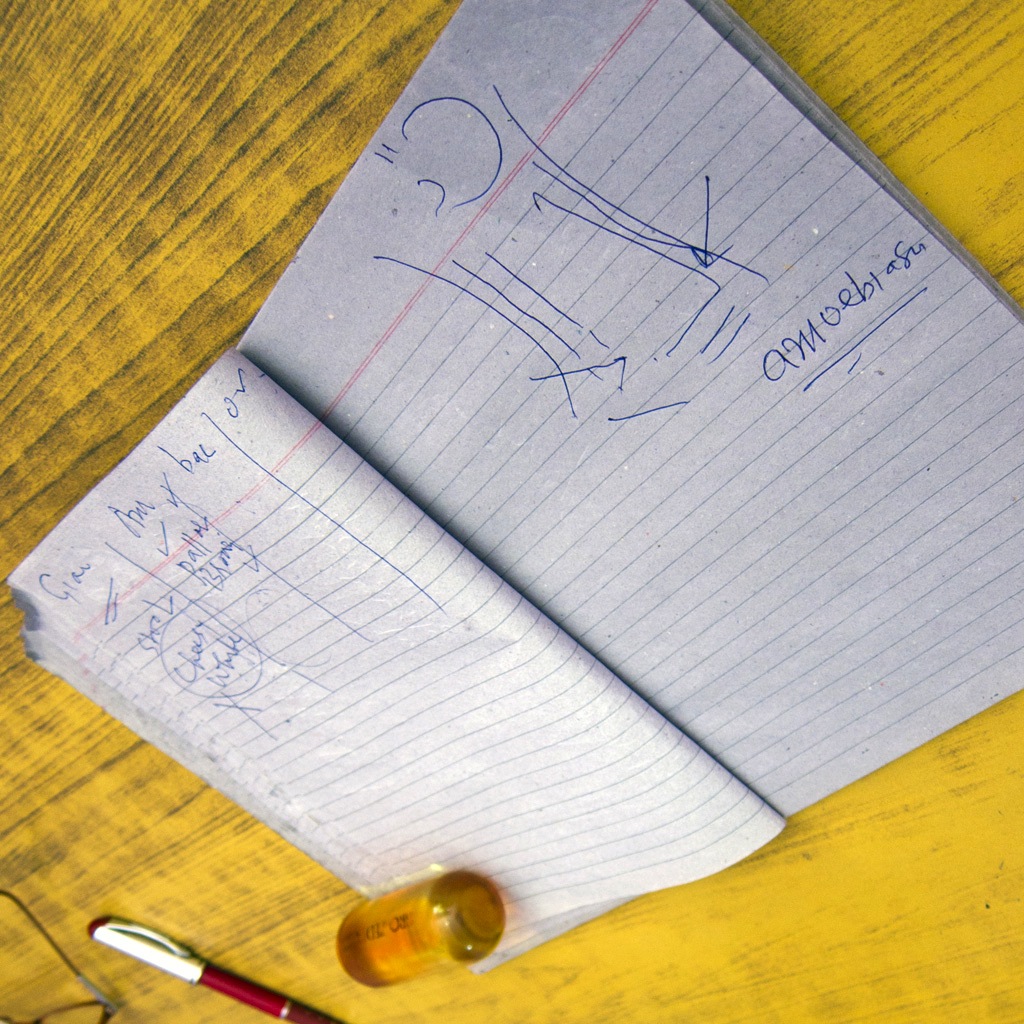
My only consolation is that both illnesses respond to the same medication (although “I’ve read” that amoebic dysentery is considered far worse and can spread further in the body). We left with five separate and surprisingly inexpensive medications—a powerful antibiotic for dealing with protozoal infections, another antibiotic for secondary bacterial infections, and various drugs to deal with symptoms of nausea, diarrhea, and cramping. The primary antimicrobial drug causes as many negative side effects as the symptoms of the disease itself. I dream of nanodoctors.

We were instructed to take the medicine two times a day for seven days. Our last dose will be in the New Delhi airport as we depart the country.

1 My friend Fausto knew someone who referred to the disease as “Girard Ia,” which sounds more like a French-Japanese design firm than a Parisian zoologist whose scientific contributions we honor in sewage-polluted water all over the world.