
Today is the 61st anniversary of the controversial Seventeen Point Agreement between Tibet and China. Activists, dressed in traditional Tibetan dress, handed out fliers disputing the validity of the agreement.





Gentrification, imperialism, perishing languages and cultures—I realize these are nothing new, but the scale of these forces today seems overwhelming. It’s these factors that brought me here in the first place (some people say that “one person can make a difference”). Volunteering in an exile community in Northern India must have some impact, otherwise, what am I doing here? Walking up Temple Road, Lobsang explained that every act—even a supposedly charitable one—has to be evaluated based on intent. If you give money or time because you want to appear charitable, there will be negative [karmic] consequences; people will eventually discover your true intent. He then repeated this Tibetan expression:
ལག་པར་ཤ་ཡོད་ན་ནམ་མཁར་བྱ་འཁོར།
Literally: If one has a piece of meat in the hand, the birds will hover in the sky.
Implication: If one has knowledge and wealth, others will gather around him [automatically].
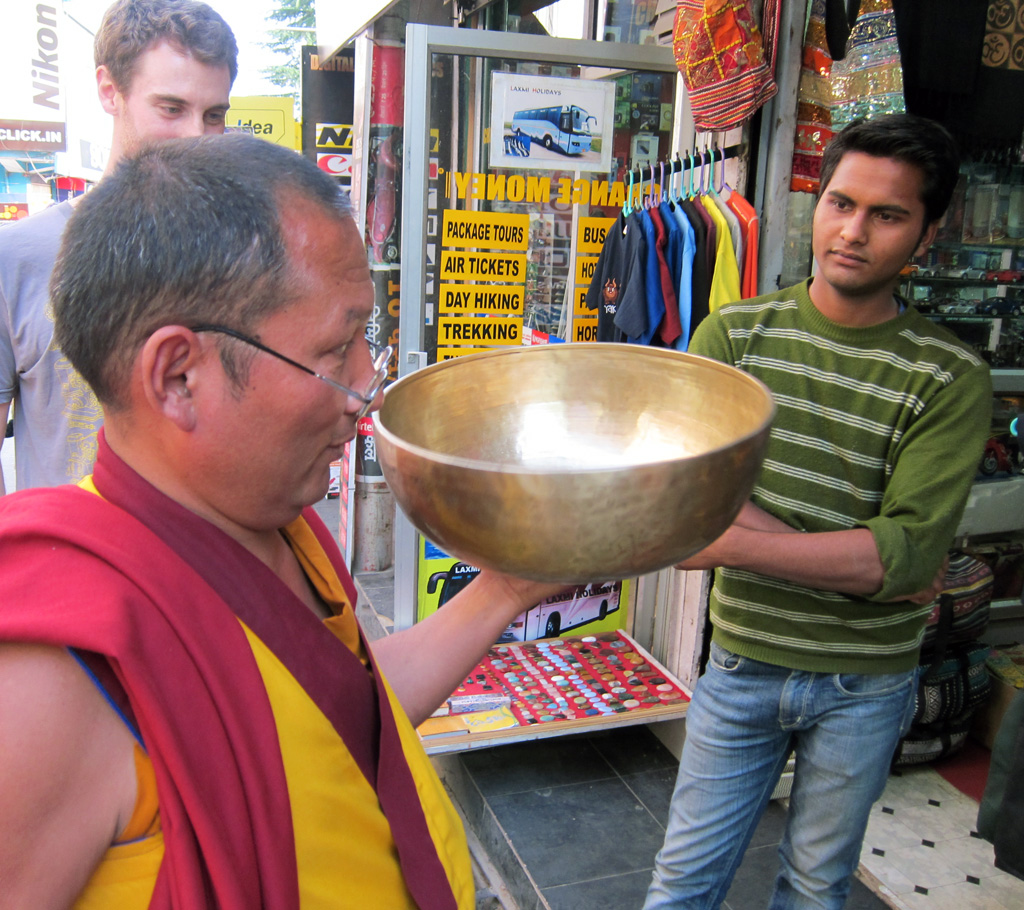
Geshe Kunkhen says that being compassionate to all sentient beings is nearly impossible if you’re starting from scratch. It’s better, he says, to first practice on yourself. Focus on your shifting attitudes—happiness and misery—and carefully analyze these mental states until you can identify their true causes. Which actions result in well-being, and which cause misery? Comprehending the nature of suffering is a prerequisite to helping others. Think locally, act globally (in that order).
One Tibetan I met, who is now a social worker in Canada, described his time doing social work in Dharamsala. In his view, the place stinks of people trying to make a difference. “Why don’t you go back to your country, solve homelessness, the medical system, inequality, and social injustice, and then come back here and show me how you did it? Until then, don’t tell me how to run my country.” I couldn’t agree with him more, and yet I am one of the people he’s describing. Perhaps I have a lighter touch than the stereotypical American, but the issue here is intent, not style or appearance.
He helped get the Archive up and running in its earliest days, and he genuinely approved of my efforts to build a database. He also noted, as several others have, that many organizations in Dharamsala have their own archives. Wouldn’t it be better if they worked together, providing a single access point to all that content? This is something I agree with, but my affiliation, just by chance, has always been with Namgyal Archive. It would be a bit like coming to San Francisco for an internship at BART and trying to unify them with CalTrain, MUNI, and AC Transit by the end of the summer. On paper it makes sense: all these organizations are supposedly for the public good, but the walls between fiefdoms can’t be broken down in just a few months.
My only consolation is that any work we do now will make database unification easier in the future. And where there was previously little organization, a relational database is a notable improvement. Still, it’s all technical trivialities compared to unifying the policies of multiple institutions. The thankless task of standardization.
Building the database for Namgyal Archive requires a balance between training and getting the job done. Good training has no ego to protect, emphasizing learning and independence over reliance on teachings. Bad training prioritizes its own survival, promising independence while demanding the opposite. Ultimately, learning requires motivation, and motivation requires incentive, which the act of teaching alone can’t provide. As a volunteer from another country, I may have the skills to explain how a database works, but I can’t provide cultural incentives to motivate the staff’s learning.
An American who has worked here for the last decade laments that few people within the Tibetan community, he says, strive to excel. He thinks it’s largely because there’s no incentive within the community to go above and beyond. Without the cultural allure of higher paying jobs or increased recognition, one ends up with either a ho-hum work ethic or immigration “brain drains” to places where those incentives do exist (the U.S., Canada, Europe).
Training aside, my commitment is to get the job done with high standards, just like a paying gig for a reputable client (which is all true, except for the pay). Someday, I hope to unravel this mystery of motivation. As a teacher, is it possible to transmit a sense of curiosity and ambition to another person, or are these qualities only generated from within? Perhaps the best you can do is show, not tell—live by example—and let the cards fall where they may.
I knew someone volunteering in Africa who also had conflicted feelings about all this. Someone there recommended a transcript of a speech by Monsignor Ivan Illich, a priest-turned-philosopher who, after being a missionary for several years, formed an organization designed to reduce the harm he felt people like himself were inflicting on the people living in developing countries. It’s called To Hell with Good Intentions.
Come to look, come to climb our mountains, to enjoy our flowers. Come to study. But do not come to help.