After returning from Dharamkot, Lobsang and I discussed my meeting with Geshe Kunkhen and his brother.
We met Tenzin Tsepag’s brothers.
At “Pizza Hut?”
Yeah…
He’s feel not well.
We also met the younger brother—the singer.
So I can call him tonight or I can… if you… need recording…
Yeah…
His voice is excellent, so if you need recording I can call him tomorrow.
Okay.
He is very happy and very [carefree]…
Outwardly he behave didn’t he’s going to be a big monk. He’s very happy and try to spend time just, you know, happily. So tonight or tomorrow I can call him.
Okay.
I remember this, yeah?
The microphones?
Still you are keeping… no one knows this is a microphone [laughs].
There are a number of Tibetan Buddhist chanting recordings available, and Geshe Kunkhen has participated in many of them. When he came to the Archive on Tuesday to record in the soundproof room, he said the best recordings include multiple people chanting instead of only one, and he dreams of someday recording different Tibetan chanting styles together at the same time.
I did record four times in United States. I give this donate for my monastery. With the groups, I’m the chant master, then I [started an] organization, then I give this master recording for monastery… directly go to [my] monastery. This good.
Are they all recorded in San Francisco?
One, one. First record [in] 1988. Other ones recorded in: one in Atlanta, one is [in] Iowa, [in a] studio, [and] then [a live show]…
…I hear some people talking and knocking. No, no moving [the pages during the recording]. I can’t hear [through these “headphones”], yeah?
It’s only the microphone.
Microphone…
[Lobsang explains in Tibetan]
Now [this traditional chanting] is almost going to disappear. I want to record. I want to send [to] all school[s] and children can learn this. [explains in Tibetan] The religious teacher[s] at every school… they’re asking me but I have no time to record these things.
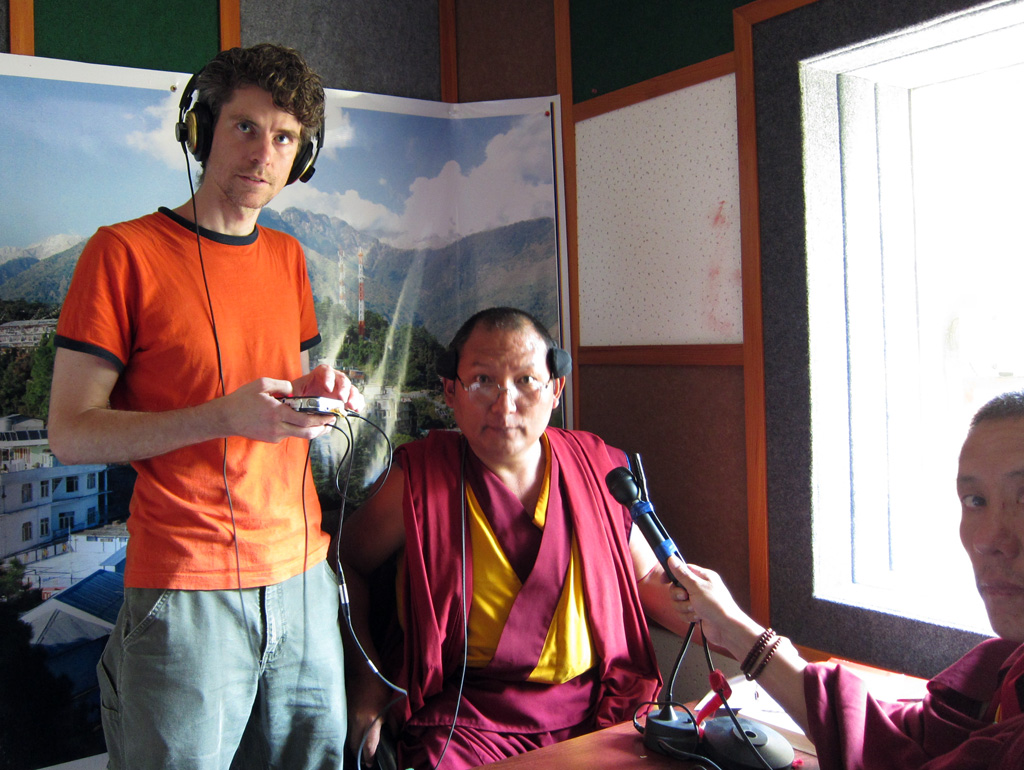
Binaural recordings are made by placing a pair of omnidirectional microphones next to each ear, so the sounds are picked up from the same location as your ear would. This positioning, along with the fact that your head blocks some of the sound from reaching each mic, recreates the sonic characteristics of your own hearing. The result can be remarkably realistic. Due to the unusual mic configuration, people often mistake binaural mics for headphones.
I’m not sure if Tibetan chanting (especially the multiphonic style) has ever been recorded this way, but it seemed like an interesting experiment and Geshe La was enthusiastic. We also recorded with a typical dynamic mic (to an Edirol R4 recorder) as a control for our experiment.
It’s okay?
Yeah.
Too far?
No, no, that’s okay.
Here?
[Lobsang and Dave laugh]
No, it’s supposed to be where your ears are. It’s actually supposed to be on your ears, but I think that will too uncomfortable.
Testing?
Yeah, the only thing is: I had to unplug this because the power was making a buzzing sound in the [microphones].
[Lobsang] I see…
When I turn this on, I can hear [the buzzing]. This is very strange… there’s an electrical signal and if I do this [touches Geshe Kunkhen’s arm] the bad sound goes away.
Skin, okay…
Is that okay? Just like this?
Elbow, yeah… shoulder. This [book cover], you read this.
The Aspirational Prayer to the Realm of Great Bliss, Dewachen.
Yeah. This [song has] a very good tone. Everybody like[s] this.
[Lobsang] [The monks] memorize [texts] like this.
This [text] is very small [even though it may seem long].
[Lobsang] Maybe here [at Namgyal] even me memorize 500 pages.
Yeah, Namgyal monks, they have to memorize very big [texts]: Kalachakra text… 200–300 pages. Kalachakra text [alone]. These are very powerful words.
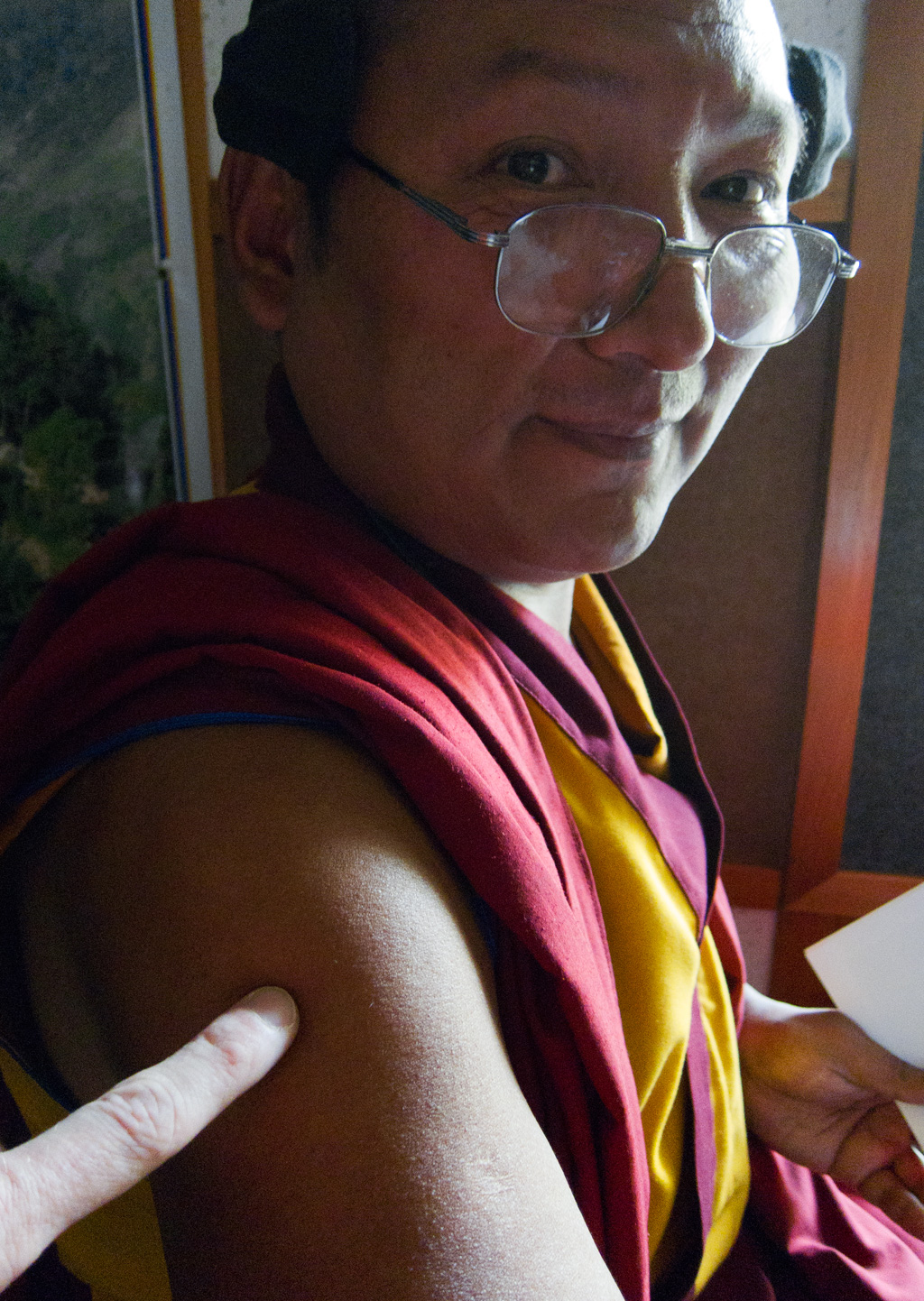
In theory, listening to a binaural recording places you in the “sonic shoes” of the person wearing the microphones. To some degree, you should feel as though you yourself are the one chanting. There are some issues, like the fact that we couldn’t position the mics exactly over his ears. Still, if you’re curious, have a listen wearing headphones (speakers significantly diminish the binaural effect).
How old were you when you started practicing the multiphonic [chanting]?
Thirteen. You can check my sound…
Yeah, you want to try?
[Low frequency, multiphonic chanting]
Here is an excerpt from The Aspiration of Sukhavati, the Pure Realm of Great Bliss (by Raga Asya), chanting by Geshe Kunkhen.
Emaho! In the direction of the setting sun, beyond innumerable worlds, slightly elevated,
is the land of the noble beings, the perfectly pure celestial realm Sukhavati.
It is not visible to ordinary eye sight, but clearly visible to a mind endowed with pure vision.
In that realm resides the Bhagavan Jina Amitabha of ruby red colour in a dazzling brilliance.He has all the 32 marks of superiority and the 80 perfections,
the crest protrusion on his head and the wheels on his feet and all the rest.
He has a single face, and two hands in contemplation mudra, holding an alms bowl,
and he is robed in the three Dharma robes sitting crosslegged.He is seated in vajra posture on a 1000-petalled lotus with a moon seat,
and behind his back is a bodhi tree.
By his compassionate eyes he beholds me from afar.On his right is the bodhisattva Avalokiteshvara, of white colour, holding in his left hand a white lotus;
and on his left is the bodhisattva Vajrapani, of blue colour,
holding in his left hand a vajra marked lotus;
both have their right hand extended towards me in refuge bestowing mudra.These three chief deities appear in splendour like Sumeru,
towering, immovable and indestructible.
Surrounding them are millions and milliards of bodhisattva mendicants,
all of golden complexion, adorned by the marks and perfections,
and robed in the three Dharma robes of bright yellow colour.
Since they do not discriminate between devotion from near and from afar
I prostrate devotedly by my three gates right here.As I recognize the Dharmakaya Amitabha as lineage Buddha,
from his right hand radiates light becoming his emanation Avalokiteshvara,
and further becoming a thousand million secondary Avaloliteshvara emanations;
from his left hand radiates light becoming his emanation Tara,
and further becoming a thousand million secondary Tara emanations;
and from his heart radiates light becoming his emanation Padmasambhava
and further becoming a thousand million sacondary Padmasambhava emanations.
I prostrate to the Dharmakaya Amitabha.During the six periods of day and night his Buddha eye continuously beholds all beings with affection.
He always knows whichever thoughts arise in the mind of every single sentient being,
and he always hears distinctly and without confusion whichever words are spoken by every single sentient being.
I prostrate to the All-knowing Amitabha.It is declared that anyone, except one who has committed the five inexpiable Dharma abandonments,
who offer this aspiration with faith,
by offerig this aspiration to be reborn in Sukhavati
they will at the time they enter the bardo be drawn towards that realm.
I prostrate to the Guide Amitabha.It is declared that Amitabha’s vitality will remain for countless aeons without passing beyond suffering,
and just now appears openly, and anyone who supplicate with single pointed devotion
will obtain the power over life except for already ripened tendencies,
and the ability to live for a hundred years,
and he will be protected against all untimely death.
I prostrate to the protector Amitayus.It is declared that even if one could fill all of a milliard worlds countless myriads of times with jewels and give away as gfts,
hearing but once the name of Amitabha and Sukhavati and joining the palms in faith would have greater merit.
Therefore I prostrate devotedly to Amitabha.Whomsoever on hearing the name of Amitabha develops uncontrived devotion
from the depth of his heart and bones just once,
he will never be repelled from the bodhi path…
And here is a multiphonic chant, also by Geshe Kunkhen.
After we finished recording, we discussed Geshe La’s next big step in the monastic world: taking the exam to become a monastery disciplinarian.
This is very famous of Mind Training’s Practice words. You like it? This is very powerful text. Root tantra of Guhyasamāja. I want to record this. Very powerful text—
Root tantra?
Root tantra…
Root, like center?
Root, root, yeah. Core. Core tantra…
So you have to go up into the hills to memorize text for South India?
Yes. This text… no, this text, [and] also commentary of this… Memorize the commentary and then I’ll make a recitation in front of monks. This is like [an] exam. They exam to me.
[Lobsang laughs]
I’m not really a disciplinarian—I have no time to watch [the monks]. [My] title is disciplinarian… first [level]: abbot, then another one [second level]: it’s almost like same. Abbot is just [there to] give teaching, not taking care of anything—just giving teaching and that’s it. I’m below to him [the second level].
So once you do the exam, you’ll be a disciplinarian?
That time… after six months, yeah. This is my final exam in my life! I did a big exam in monastery; I finished in 1999. That means [I am a] geshe. Now this [next exam] is beyond [that] general exam—like an interview. It’s big difficult.
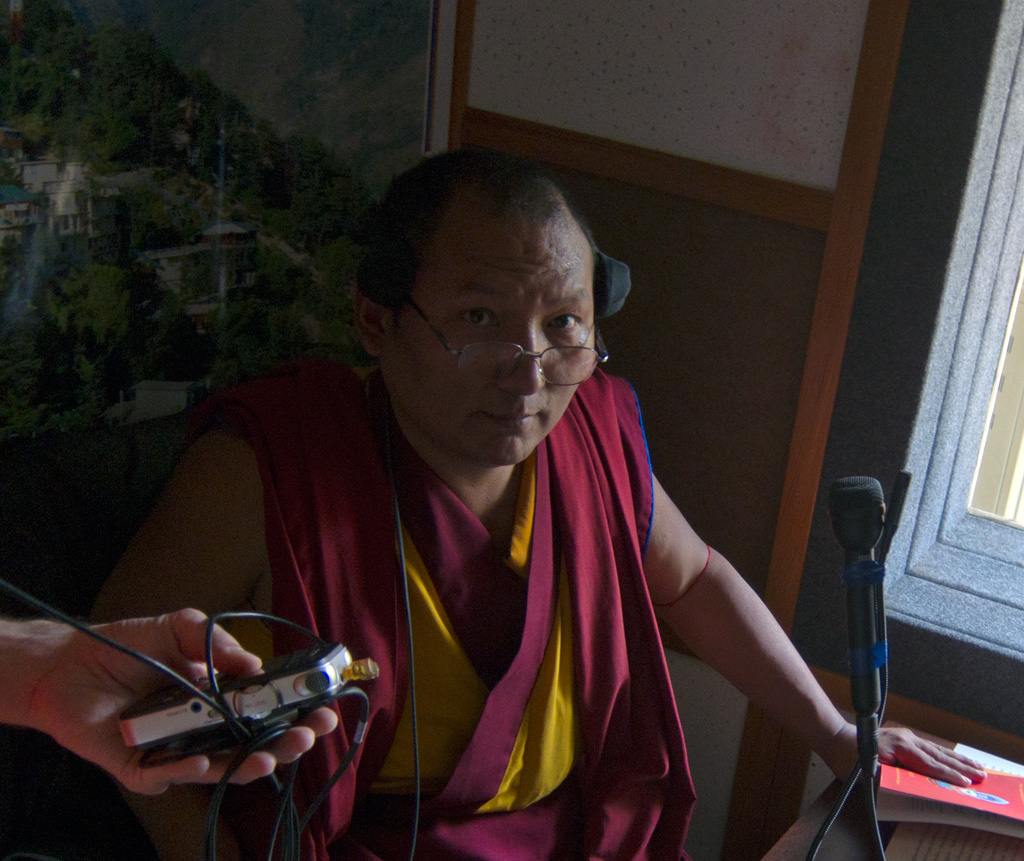
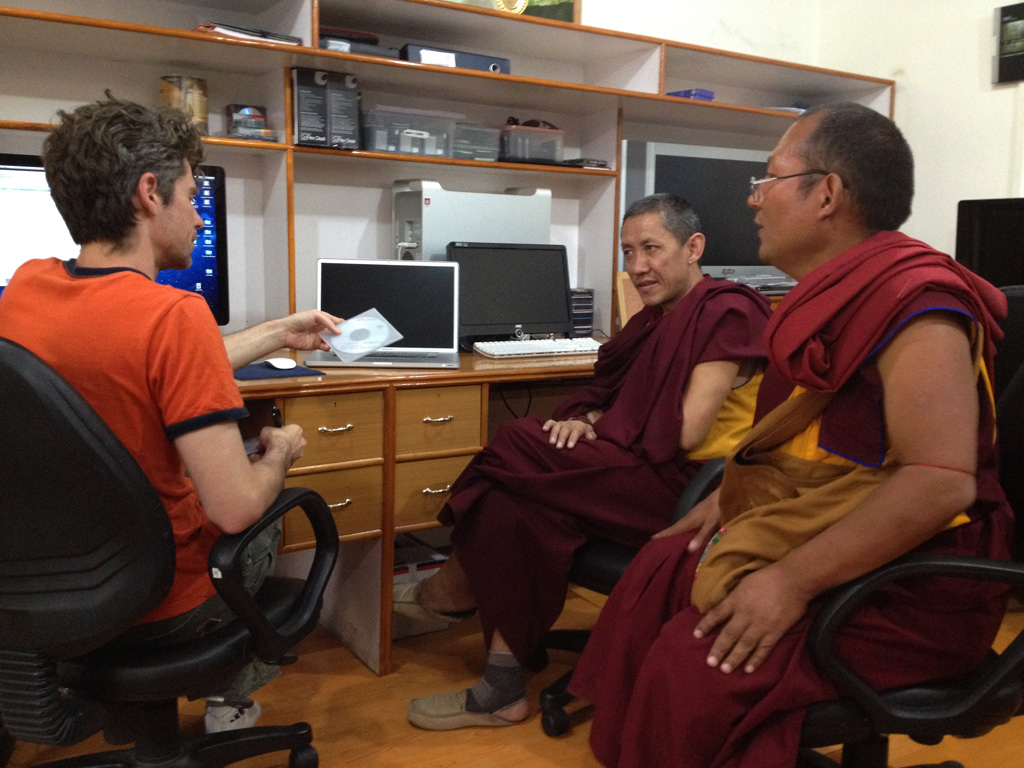
I told Geshe La that I’d make audio CDs of his recordings, and he asked when he could come back to pick them up. As we sorted out the details, he mentioned that he had made a previous recording with Lobsang, but things at the Archive are so busy that he never got a copy.
What time I come back?
[Lobsang in Tibetan]
Yeah, [Lobsang] is very busy…
Lobsang: It means, he said I’m not calling him [back].
[Geshe Kunkhen laughs] I did one record one time here [at the Archive]. He’s very busy, but he don’t give me… [laughing]… record. That’s why I difficult to ask him to make record.
As a parting note, we got to discussing lucky and unlucky numbers. For example, some of the chants he recorded must be repeated a certain number of times—three is good, twenty-one is better.
[In] Tibetan, thirteen number is best number.
Yes…
Black, also! Thirteen, black. Black dog—thirteen black dog[s], thirteen black crow[s], thirteen yaks. Everything is [a pack of] thirteen, then [your life has] no problem.
[Lobsang laughs]
We are looking very good things.